I Built an AI That Writes Bass Tabs (And It's Actually Getting Good)
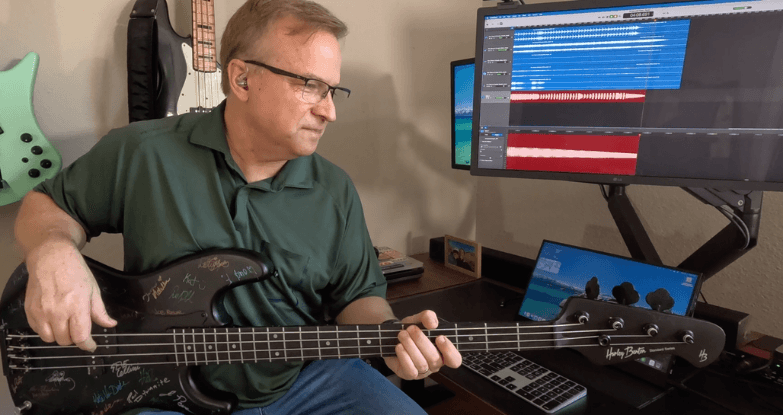
You've probably noticed in my cover videos that there's an app visible on screen showing multiple tracks, including the one I'm recording. That's GarageBand -- a free app available to all Mac users. But where do those tracks come from? Here's the story.
For the past year or so, I've been building an AI-powered music tool called TabGen.ai . You upload a song, it separates the audio into individual stems (bass, drums, guitar, vocals, piano), and then generates bass tablature automatically using machine learning.
Why I Built It
Two reasons:
First — I got tired of hunting for accurate bass tabs online. Half the tabs on free sites are wrong, and even the paid ones sometimes have the wrong version or skip sections entirely. I wanted something that could listen to the actual recording and tell me what's being played.
Second — I work at AWS during the day, and I wanted a real project to sharpen my AI/ML development skills on. Reading docs and taking courses only gets you so far. Building something end-to-end — training models, deploying inference pipelines, wrestling with real-world data — that's where you actually learn. Combining that with my bass hobby made it a project I'd actually stick with. I've since been able to earn my AWS GenAI - Practitioner , GenAI - Professional , and ML - Specialty certifications thanks largely to this experience.
How It Works
The app does a few things:
- Stem separation — AI splits the full mix into isolated instruments. This is what lets me pull individual stems into GarageBand for practice and recording.
- Bass transcription — A custom neural network I trained analyzes the isolated bass stem and detects every note: pitch, timing, duration. Then it maps those to fret positions on a 4 or 5 string bass.
- Tab editor — The generated tab shows up right in the browser where I can play it back, make corrections, and use it while I practice.
Where Things Stand
It's not perfect — and honestly, it might never be 100% for every song. Dense mixes where the bass is buried under heavy guitars are harder to transcribe than clean funk or disco lines. But on a lot of songs, it gets surprisingly close. I'd say it nails about 70-80% of notes on most tracks, which gives me a massive head start compared to figuring things out purely by ear.
I'm still actively improving the AI model (training on more songs every week), refining the tab editor, and polishing things up for other musicians to use. It's also been a great excuse to go deep on things like GPU inference, model training pipelines, and audio signal processing — skills that translate directly to my day job.
What You See in My Videos
Here's what's happening:
- I've uploaded the song and separated the stems
- The individual tracks (bass, drums, etc.) are loaded into GarageBand so I can mute/solo and play along
- The generated tab is on an iPad off-camera as my reference while I track my bass part
It's become a core part of my workflow for learning and recording covers.
Want to Try It?
I'm ready to open this up for other players. If you're interested in trying it out click here . Then, drop me a message — I'd love to get feedback from fellow bass players.
More to come on the technical side (how the AI actually "hears" bass notes) in a future post.